Since the 1970’s, my advice for people looking to improve performance of their computers has been to increase memory first. It almost always yielded a more noticeable speed boost than a higher clock speed processor, a newer next-gen processor, or increased bus speeds, or increased storage. For the most part, system performance was RAM-limited more than anything else.
For the past few years, that has been changing. Memory management has steadily improved, and memory has become so inexpensive that most systems came equipped with as much as was reasonably needed. That may change as people add LLMs to their computing mix, but increased memory simply is not the sure-fire performance trick that it once was.
When I bought my latest laptop (a Framework 13” Ryzen) I bought a relatively paltry 32 GB of RAM. I got it as a single module, so that I could easily double the RAM without having to throw any away, but I wanted to see if the Framework and AMD processor could really substitute for my MacBook Pro.
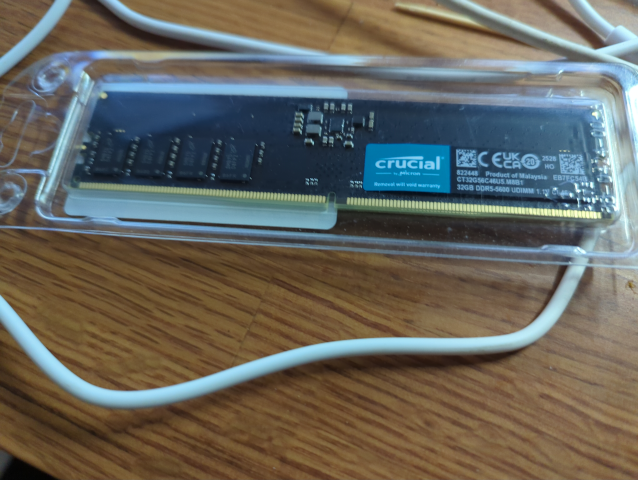
All went well, and close to two years in I am most happy with my switch from a MacBook to the Framework running Fedora. My storage was a bit constrained (1 TB) so I decided to upgrade both RAM and storage. Back on October 17, 2025 I ordered a 32 GB DDR5 RAM module. It was scheduled to be delivered a few days later. Then, suddenly, it was delayed by over a month. That coincided with the great Amazon Web Services US-East-1 outage. Did my order get hosed by Amazon’s flailing cloud service? It also coincided with a more-than-doubling of RAM prices due to manufacturers shifting to providing chips to LLM (“AI”) servers. Was this a way of covertly canceling an order that was no longer profitable?
The revised delivery date, Nov 24 (already more than a month after the original date) came and went, and Amazon said I had to wait until Nov 27. That date came and went. I contacted Amazon and suggested that it was pretty obvious that the order was lost, and could I get a replacement shipped. “Sure!” then “No, but we can give you a refund.” So I reluctantly took the refund, but found that the RAM I had paid $108 for would now cost $299! Aack! I was only ordering it just because, so I decided that I didn’t need it that badly.
Well, a couple of days ago, seven weeks after my original order, the package showed up. Amazon wants me to return it, of course, but I’ve asked if I can just keep it for the price I originally paid. Since they sold it at that price, that seems fair. We’ll see what I hear back. In the mean time, I think I’ll install it.
—2p
addendum 2025-12-06T17:08-10:00
Turns out I ordered the wrong RAM anyway, so back it goes.