Back in the late 1990’s, I was beginning to generate medical records on my Newton MessagePad. No hospital, medical school, or clinic with which I worked had any electronic medical record (EMR) capability, so I had to print the records out and put them in paper charts. Still, my paranoid nature wasn’t comfortable with the only copies of my notes being completely under someone else’s control.
Would people in medical settings actually remove or alter records to protect themselves from blame, lawsuits, or embarrassment? You bet they would. So I kept copies of virtually everything I wrote. Still, I could see a case where, when my copy differed from what was (or wasn’t) in the paper chart, people would tend to be skeptical of this newfangled technology and believe the paper instead.
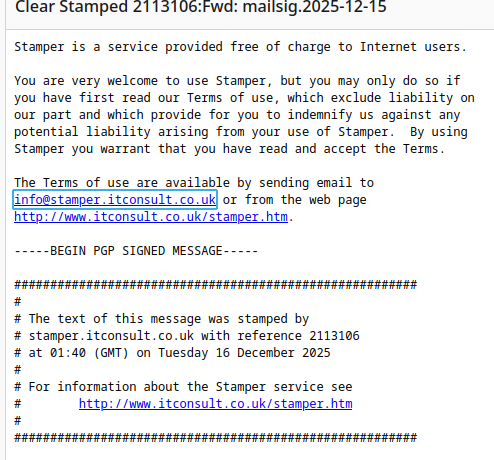
I had done a lot of work in cryptography prior to my medical career, and I knew that I could digitally sign my records, but I didn’t think that would hold much weight if there wasn’t some neutral way to assure the integrity and timeliness of my records. Then I discovered a new service where you could email them a short message, they would digitally time stamp and sign it, and send the signature back. For free. So I coded up scripts that, once a week, would take a snapshot of all the medical records, emails, photographs, and scans I’d made during the week. The script would then generate a hash or digest of those snapshots. The hash is just a relatively short number that mathematically verifies the integrity of the original data, without revealing its content. So the hash would be free of any private information, and I could just email it to clear [@] stamper.itconsult.co.uk, and the service would add a date and time and a digital signature. In addition, it would publish a hash of its own signatures on a public forum. Therefore, if anyone were to try to claim that I had forged or altered any notes post-hoc, I could show that stamper.itconsult.co.uk had undeniably certified that the unaltered document existed at the time they signed it. Even if the good folks at stamper.itconsult.co.uk somehow became corrupt, the publicly published stamps would continue to provide cryptographically solid evidence of the date and authenticity of the documents.
It became such a habit that I have continued to do my weekly timestamps, though now there are no medical records involved. While I was sending out my hashes a couple of weeks ago, I thought “wow, these guys have been at this a long time, and for free.” It occurred to me that they would probably be shutting the service down soon, and I would have to find an alternative or give up on having my personal records time stamped. When, a few days later, I got a message from stamper, I figured the jig was up.
I was wrong! They were writing to announce a modernization of the service which, of course, is nearly three decades old. I wrote back to tell them that I have relied on the service almost since its inception. Fortunately, I have never had to go to court and claim that I had cryptographic proof of the accuracy of my records, but in fact the existence of that proof is why I’ve never been in court. I’ve had several smarmy lawyers tell me, on the phone, of course, that they would challenge the authenticity of my records. After a quick explanation of digital timestamping, they all backed down.
Mahalo nui loa to stamper.itconsult.co.uk!
—2p