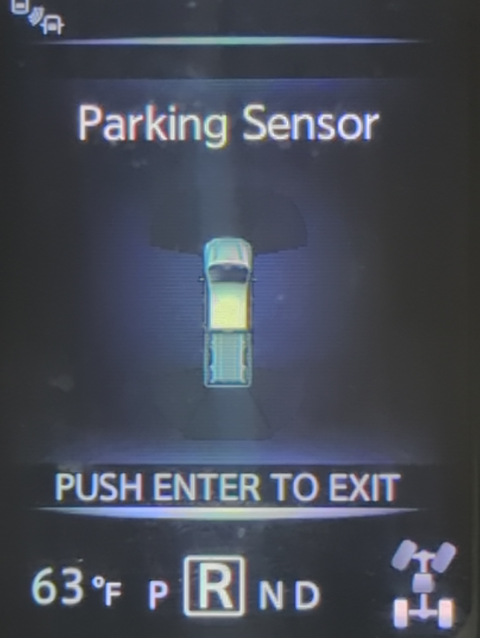
Timmy the Titan is a fine motor vehicle. For a big diesel truck, he’s quiet and comfortable. He’s been pretty reliable. He’s got a fairly modern (for his model year, 2016) instrument cluster. But, wow, how it fails.
The above display is typical. It’s supposed to show you if there are obstacles in front, behind, or to the sides of the truck when you’re backing up. It’s a big truck and kind of difficult to see out of, so those warnings can be important. At the same time, they’re accompanied by screeching alarms. Ear-piercing, distracting, I-can’t-think-straight-with-that-noise alarms. Those loud alarms are probably a very good idea if, say, you’re backing up in a driveway or parking lot and there’s a kid on a bicycle behind you that you didn’t see.
There are other times, though, like when you’re trying to parallel park or turn around at the dead end of a narrow alley when an already stressful situation is made worse by those alarms assaulting your auditory nerves. You want to MAKE IT STOP so you can focus on the delicate task of driving. Fortunately, they’ve given you a way to stop the alarms. You simply have to know that, when they say “PUSH ENTER TO EXIT,” that they mean MAKE IT STOP. And if you know that, then you have to figure out where this “ENTER” is that you can push to EXIT. [Hint: it’s on one of the steering wheel spokes, nowhere near the ENTER TO EXIT message.] All with alarms blasting your brain. But let’s say you’re a lot smarter than I am and figure this out and push the ENTER key and you EXIT from the alarms. Great! Now you can just rely on the visual indicator of how close you are to objects around you. BUT WAIT! When you push ENTER you also EXIT from the visual display as well! It’s all-or-nothing, buddy: listen to our howling alarms or drive blind. The choice is yours.
I once had to back out of a very narrow, ⅛ mile long, winding dirt path with vegetation hanging over it. Having access to the proximity sensors would have been most useful, but having the horns blaring in my ears wouldn’t have been tolerable. I ENTERed to EXIT and just had to back the huge truck out using the side mirrors and the low-contrast, low-resolution backup camera.
Oh, it’s also worth mentioning that the obstacle display is only visible when you’re going in a straight line. If the steering wheel is turned — as, say, when you’re backing up down a twisting path — the steering wheel spokes completely cover the proximity alerts.
Do you know what Nissan thinks is far, far more important than the aforementioned kid-on-a-bicycle? Your diesel exhaust fluid level! For those who don’t drive modern diesel vehicles, DEF is a fluid (urea solution) that you have to periodically add to your diesel vehicle that lowers NOx emissions in the exhaust. When Timmy gets down to only having 35% of his DEF capacity (good for hundreds of miles of driving), he obscures the obstacle alert screen completely with a message saying you’re getting low on DEF. Because, naturally, knowing that you’ll have to add DEF some time in the next 400 miles is so much more important than knowing a kid on a bicycle is in your immediate driving path.
If we’re in the truck and it has selected my phone instead of HA’s as an audio source, good luck changing it. The screen to do so is about four layers deep, and the top layers don’t even hint at the idea of choosing an audio source.
There’s another potentially hazardous situation: you’re driving and your windshield fogs up. Being able to see out is an important feature of windshields. That’s why they’re equipped with defoggers. And Nissan intelligently provides a single, physical button that will activate the defogger. Now, can you find it?
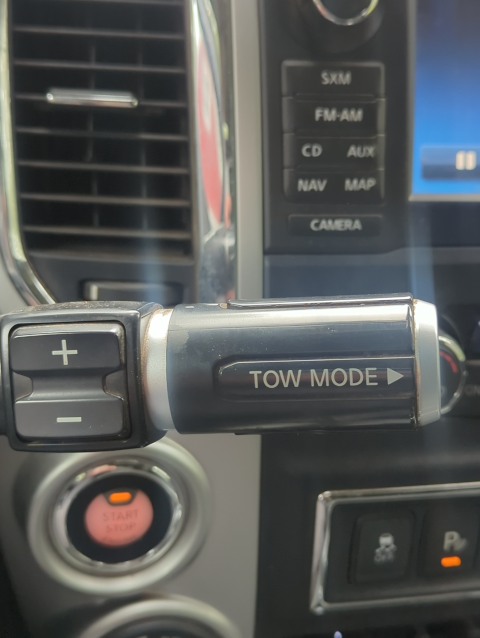
No. No you can’t. And why not? Because, when the car is in drive (because, you know, you’re driving), the shift lever completely covers the defogger buttons. But, hey, it makes it easy to know how to activate TOW MODE just in case a trailer suddenly becomes attached to your vehicle as you’re barrelling down the highway (blind, because you can’t defog the windshield).
It just goes on and on. I suspect the people in charge of human interface design at Nissan don’t drive their own cars.
—2p