We’re remote. As a state, we’re 2,000 miles from the nearest continent. As an island, we have much lower population density than, say, O’ahu (the island where Honolulu is). Even on our island, we’re on a remote, rural part far from population centers. Like many of our neighbors, we live on a one-lane, long, dead-end road. One tree falling down (and there are many trees, and they fall often) can not only block the road, but can take out our phone lines and internet fiber. Cell phone service, despite the cheerful coverage maps published by the carriers, is all but nonexistent. In an area-wide disaster such as a hurricane, it would likely be a very long time before authority figures work their way around the island from the nearest city to our distant part of the coast.
On the other hand, we’re a diverse and resourceful lot. We’ve got doctors, nurses, dentists, hikers, veterinarians, lumberjacks, contractors, EMTs, firefighters, and more. A number of us even have CERT training. But how do we know where we’re needed if the phones and internet are down and roads are impassible?
Some of my neighbors have put together a network using general mobile radio service (GMRS) radios. These are remarkably inexpensive handheld walkie-talkie like devices that communicate point-to-point over several kilometers. Due to our low population density and rugged terrain, not any two people can communicate directly this way, but our neighbors did a lot of studying the terrain and did trial-and-error tests and put up a centrally-located repeater that’s in a place where anyone in the neighborhood can sent to it and receive from it. We do weekly check-ins where we all chat and measure our signal strength and generally make sure that we stay comfortable using the radios and that they stay charged and functional.
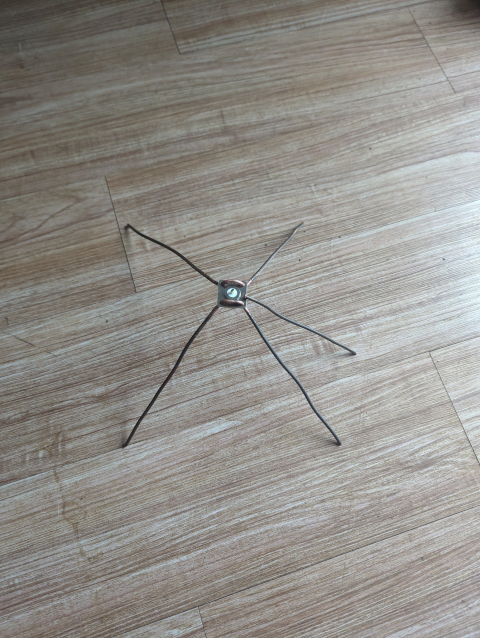
One thing we discovered is that using the handhelds indoors in homes with metal roofs (quite common here) doesn’t work too well. We wanted to see if we can overcome that limitation by building a simple outdoor antenna. I’m sort of the antenna guru of the group, so I got some connectors and coax and copper wire and assembled a simple quarter-wave + ground plane antenna. It took a couple of dollars in parts and about 20 minutes — until it came time to solder everything together.
My soldering iron lives in a little cardboard box with space under it for its power supply and a spool of solder. The solder goes with the soldering iron. There’s no reason for them to ever be separated. Yet when I opened the box, the solder was gone. I searched for about 2½ hours to no avail. So a project that should have been completed in half an hour has now taken up about three hours and still isn’t done. Sigh.
—2p
addendum 2026-07-22T11:58-10:00
Found solder and finally finished the GMRS antenna. It even has a perfect standing wave ratio.