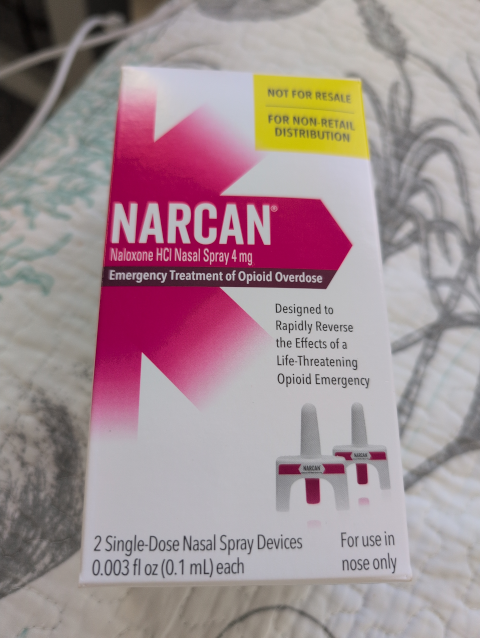
The front door of the hospital is next to the emergency department entrance, and next to that was a box on a stick that looked like a rather industrial Little Free Library. Instead of books, however, it held boxes of Narcan, available for free to anyone who wants one. This is an awesome harm reduction strategy.
If you’re blissfully unaware, naloxone is an opioid antagonist. That is, it reverses the effects of opioids. Should you encounter someone who is unresponsive and isn’t breathing and perhaps their lips are turning blue, there’s a chance that they’re suffering from an opioid overdose. They might not even be a habitual opioid user: fentanyl is showing up in all kinds of street drugs these days. They might have thought they were taking ecstasy or molly. They might have mixed up their legitimate prescription drugs. Their pharmacy might have made a mistake. Whatever. It isn’t the moment for affixing blame or passing judgement. The risk from giving naloxone to someone who isn’t overdosing on opioids is minimal. The risks of not breathing are substantial. So if you have it, and you encounter someone who isn’t breathing, give it. Then call 9-1-1 (or the emergency services number for your locale, even if it’s 0118 999 881 999 119 7253 — warning, YouTube video). Tell the emergency services operator that you’ve given intranasal naloxone.
There are important things to remember:
- Call 9-1-1 (or whatever) immediately after giving the naloxone. You have no way of knowing if the person’s breathing stopped because of an opioid overdose or something else.
- Call 9-1-1 (or whatever) immediately after giving the naloxone. Even it there was an opioid overdose, the naloxone can wear off before the opioids do and send the person right back to not breathing. It’s best if help is already on the way when that happens!
- Did I mention calling 9-1-1? It takes a few minutes for naloxone to work. Your job isn’t to wait to see if the naloxone helps, it’s to get definitive treatment on the way. Call 9-1-1.
- DO NOT expect someone rescued with naloxone to be pleasant and grateful. If they are a habitual opioid user, they will go into immediate withdrawal. It doesn’t matter if they’re using opioids appropriately for pain control or are a recreational user, they’ll still have immediate withdrawal which means they’ll be agitated, irritable, nauseated, and in pain. There will be time later for them to appreciate that you saved their life. In the moment, though, they won’t be happy, but they’ll be alive.
Precipitated withdrawal by naloxone is, in fact, so unpleasant that I prefer to mechanically ventilate patients instead of giving naloxone if at all possible. If you don’t happen to have an oxygen bottle and bag-valve-mask, a ventilator, or an ET tube and laryngoscope AND the expertise to use them, intranasal naloxone is the life-saving next best thing.
I’d rather have someone live to call me an asshole than die on the scene.
—2p