One of our recent visitors was intrigued with our bathrooms, both of which have two features in common: a point-of-use water heater that provides instant hot water at the sink, and an electronic bidet seat. We were talking about how he could do the same thing in his home. The problem is this: both the bidet seat and the water heater are high-wattage appliances. Most bathrooms, including his, have only a single 15- or 20-amp circuit. If the water heater happened to kick on at the same time the bidet seat heated water jet or hot air blower was on, you’d trip the circuit breaker.
The water heater isn’t a tankless type; it’s actually a 10 liter tank. That means that if it is without power for a few minutes now and then, a user would never notice because the water in the tank would still be hot. The bidet seat is only using power when it’s actually in use (it uses a small, internal tankless heater) which is probably only a few minutes a day total. In other words, there’s no reason that a single 15-amp circuit couldn’t accommodate both the bidet seat and the water heater as long as you didn’t add, say, a hair dryer.
I went looking for a device that would look like a power strip, with a standard 5-15 plug on a cord and two or more 5-15 receptacles. One receptacle would be primary: it would always be connected. The bidet seat would plug in there. The second receptacle would be subordinate, and would be disconnected whenever the primary was drawing significant power. That’s where the water heater would go. When the bidet seat was in use, the water heater would be disconnected for a few minutes, but not nearly long enough for it to run out of hot water. Problem solved.
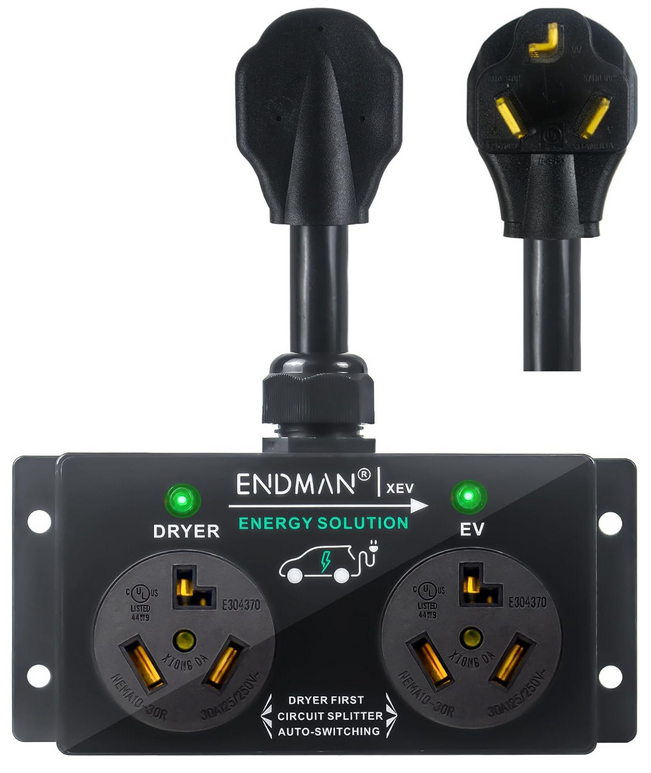
I cannot find any such device for simple 120-volt 15-amp circuits. They’re pretty common for much higher loads: witness the device pictured above that lets you plug your electric car (EV) charger into your electric clothes dryer outlet. When you are drying clothes, the EV charger gets disconnected. Any time you’re not drying clothes, the car can charge without overloading the circuit. But, apparently, nobody makes such a device for the much more pedestrian use I have in mind.
It wouldn’t be difficult to wire up such a device, or even (probably) to modify the device pictured to work with 120-volt receptacles and plugs instead of 240-volt plugs. But I don’t think Steve wants to get that involved (just as he doesn’t want to pull a new circuit to the bathroom, though I’ve little doubt he could make that happen if he felt it was worth the trouble). I just find it odd that nobody has stepped up with a plug-and-play solution.
I’ve lived in several apartments where I couldn’t have a toaster oven and microwave on at the same time. This device could solve that problem. Or a space heater and table saw in the same shop. Or a laser printer and a room heater. It’s just too useful a device to not exist.
—2p