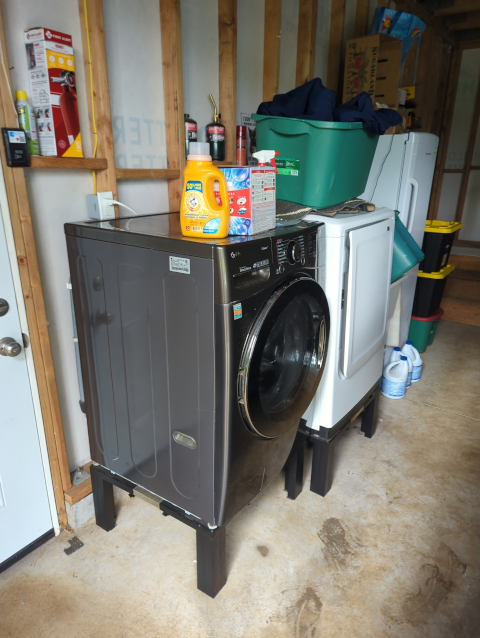
Ever since I was a kid (and that’s a l-o-n-g time) I’ve seen this bit of advice in every “home energy saving tips” blurb I have ever encountered:
always do full loads of laundry; doing small loads uses extra energy
I can now safely file this away with “never go swimming for 20 minutes after eating” as bullshit advice that people have repeated to themselves so often that they believe it without question. I suspect, too, that it might have been true when appliances were dumber than they are now. Both our washer and dryer measure loads and tailor washing and drying time to the actual condition of the laundry.
My evidence? As the all-knowing Infrastructure Man, I keep close tabs on the energy use of our appliances. The clothes dryer is the second most power-intensive device we have, after the electric car. I watch every kilowatt. I’ve noticed that the time required for both washing and (critically, energy-wise) drying times start rising faster as I approach full loads. Today, for example, I did a load that only filled the washer to about ⅔ of its capacity. Washing took ⅓ the time and drying took about half. I suspect that as the dryer loads approach capacity, then tangling and clumping slow the drying process. The dryer has to run a lot longer to get the tangles and clumps dry, and wastes a lot more energy as exhaust heat.
Also, yet another reason to dislike fitted sheets with their tendency to trap the rest of the dryer load in clumps in their elastic pockets.
—2p
PS: I am well aware that they’re such a thing as a clothesline. I’m actually a big fan. However, the relative humidity right now is 99% here, and it has rained every day but 3 since the beginning of April. I could put a line indoors to get it out of the rain, but the indoor humidity is currently 87% and I’d prefer not to do anything to raise that. As it is, everything around here is prone to mold.