Why did you go off-grid?
The question was asked by a follower on Mastodon who’s an alternative energy advocate. It seemed a simple question, then I realized that for me it had always (since some time in the 1960’s) been a given, but I’d never actually formulated an answer.
necessity
The easiest answer to the question “Why did you go off grid?” is because the place I wanted to live has no grid, so I had no choice. The truth, though, is that I was relieved that the compound had no grid service. I didn’t have to weigh the decision and could just do what I really wanted. Necessity wasn’t really the driver.
I’d been longing to be off-grid since I got my first little solar cell and a nickel-cadmium rechargeable battery in the 1960’s. Charging it all day probably gave me an hour of light from a little (incandescent) flashlight bulb, but I knew in my eight-year-old heart that this was the future.
carbon
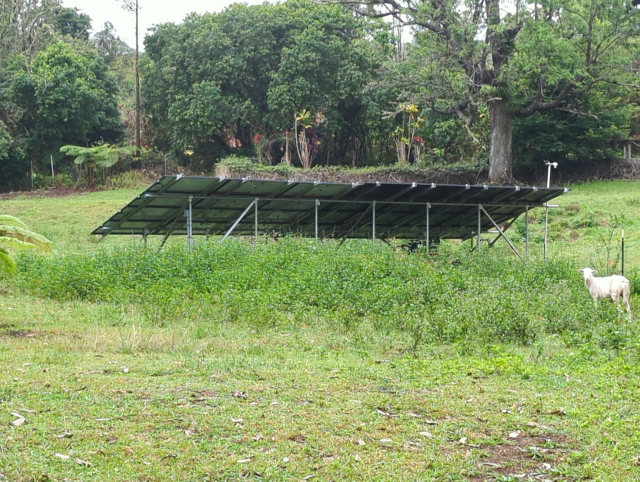
We’re killing our planet, ya, and we don’t have to be. I switched to driving an electric car. We converted nearly everything on the compound to run on electricity and put in a very large solar array. It didn’t cost that much, and we don’t compromise our lifestyle (though to live like there was an infinite grid we do have to burn a little fossil fuel from time to time, but a tiny fraction of average). I know not everyone has the capital and the space and the know-how do what we’ve done, but at the end of the day the capital investment was small (perhaps zero, but that’s thanks to tax subsidies that are no longer with us) and the expertise is becoming easier and easier to access.
Even space issues are being addressed with technologies like “balcony solar”.
retirement planning
For many years, I was a consulting engineer on large telecommunications and IT projects. I got used to doing jobs where I got paid part in advance, and the rest at job completion which was often a year or more away. I got used to not having a regular paycheck to replenish my bank account, and I quickly recognized that recurring payments (subscriptions, debt service, utility bills) were a trap if your income isn’t steady. When I left IT for medicine, my income became more steady and predictable. As I approached retirement, however, I realized that I would once again not have steady income as I don’t have income-generating investments. I could calculate, in advance, the up-front cost of a solar plant and get a pretty good handle on the ongoing maintenance costs.
Buying energy on the open market is much less predictable. If, say, someone were to start a war that caused the Strait of Epstein to close, energy costs could skyrocket. Being off grid (along with minimizing debt and subscriptions) is a way to minimize risks of costs unexpectedly increasing in the future.
self-sufficiency
In my teens, I probably qualified as a survivalist. I believed that I could equip myself and structure my life so that I could survive completely on my own in the event of an apocalypse. I no longer believe that’s a reasonable or practical goal, but I do think my community could probably limp along pretty well. We’re a resourceful lot, and there’s quite a bit of expertise and material resource in this neighborhood.
It’s difficult to survive without energy, though, and this island will certainly have an energy shortage in the event of any kind of major catastrophe. Except for solar, the grid on the island relies on oil shipped in by tanker to generate power.
Given a sufficiency of energy, it’s possible to do things that would otherwise be resource (material) intensive. We can generate drinking water and hygienically dispose of waste. We can foster small-scale agriculture, manage transportation, and operate equipment using solar energy rather than materials as inputs. Doing any of that, though, depends on having reliable access to energy that won’t be available from HELCO (Hawaiian Electric Light Company) or our local gas station or propane company.
politics
I’m sure that not everybody in the fossil fuel industry is a corrupt, money-grubbing, colonialist asshat. Really. There must be exceptions. Still, the demonstrated willingness of the fossil-fuel industry writ large to lie, cheat, steal, corrupt, extort, and wage war to protect their interests above those of the planet and humanity makes me loathe to contribute to that industry in any way.
hacker spirit
It’s just plain fun to build a complete and powerful energy infrastructure out of scrounged, surplus, used, discarded, or low-rent materials. The original quote I got for a system here was about $60,000. I ended up getting a far more capable system and spending less than $27,000 — almost all of which was offset by tax credits.
—2p