Let’s get this out of the way at the outset: this island is an archipelago, and every living thing on it came from somewhere else and it came in recent geologic time. Nonetheless, with the arrival of oceangoing vessels of trade followed by air travel and tourism and attempts to exploit the unusual climate of the place, a number of species arrived on the island that have rapidly displaced long-established populations on the island that I choose to refer to as native species. People can argue about what is or is not an “invasive species,” but “the existence of the twilight does not mean we cannot distinguish the day from the night”.
I have already waxed rhapsodic about our dead ‘ōhi’a. ‘Ōhi’a lehua (Metrosideros polymorpha) are among the first plants to grow on freshly deposited lava. They grow slowly but are majestically beautiful. They have also been crowded out by invasive newcomers such as eucalyptus and guava, and their numbers have been decimated by a fungus that causes rapid ‘ōhi’a death (ROD) and is said to be spread by feral swine, another invasive species that has upset the delicate balance that seemed to hold before so much progress came to the islands.
The whole area where I live, estimated to be one hundred thousand acres, was planted in sugarcane as a cash crop. In fact, histories report that the movement to make the Hawai’ian Islands a US state was driven by a desire by sugar interests to bypass import tariffs on sugar. All that land had to be cleared for the cane. Many native species, including many ‘ōhi’a, were decimated. Cane was king in this area until the late 1990’s, when global market pressures eliminated all the cane cultivation. But what grew back was quite different from what had been here before. (I believe our land was never planted in cane, but instead was cleared for the purposes of raising dairy cattle to supply the many cane workers.)
We are fortunate to have several relatively small areas of forest reserve which escaped the woodsman’s axe long enough to gain protected status. It takes only a few minutes hiking though such lands to appreciate the value of the native forest.
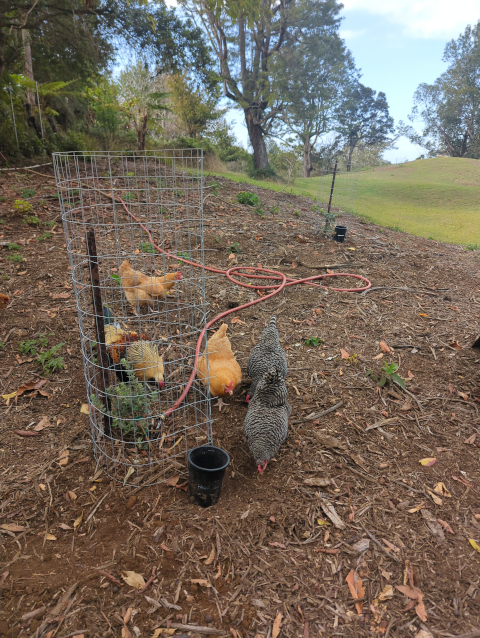
One of our goals since acquiring the compound is to start the generations-long process of restoring the land to something closer to its pre-sugarcane-industry state. We have already cleared a lot of the invasive strawberry guava and a frankly beautiful but rapid-spreading bush with purple flowers (probably glory bush). Today, we planted our first two new ‘ōhi’a trees. In the photo above, the closer tree is a red variety (ho’ohauoli) while the distal tree is a yellow-blossomed kawena ‘ōhi’a. They are enclosed in cages so that Vinda, Lu, and Naan don’t decide to snack on them.
One surprise was that the soil in the freshly-cleared area was amazing. Rich, crumbly, and moist with copious earthworms and other fauna.
—2p