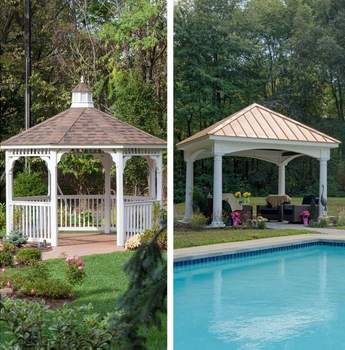
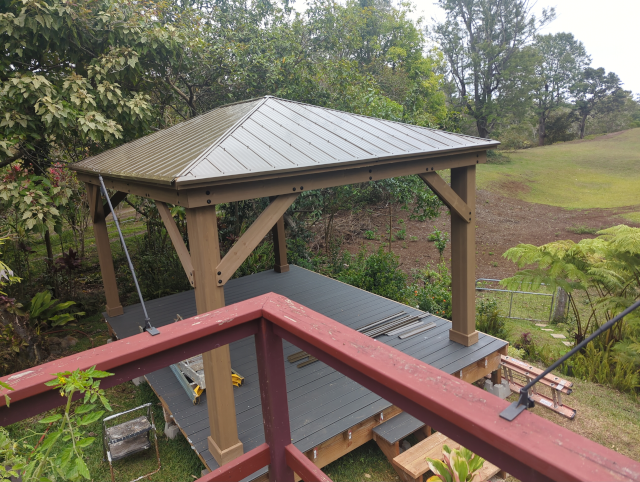
Several people have asked my why I call the pavilion a pavilion and not a gazebo. After all, the core of the structure was a “gazebo” kit.
The simple answer is “it’s mine, I built it, and I’m calling it a pavilion.”
If you want some kind of truth, you’re on your own. I will warn you, however, that the truth can be hard to find.
Multiple web sites promise to provide definitive information about what differentiates a gazebo from a pavilion, but on close inspection their definitions are fuzzy at best, with huge overlap. One site proclaims “a pavilion is larger than a gazebo” but then goes on to say that a gazebo might have a radius of 16’ or less while a pavilion’s dimensions might be “over 12-20 feet.” Not helpful. Gazebos “are often oval or hexagonal but can be rectangular.” So my 16×20’ rectangular pavilion would also still fit their definition of a gazebo. Some say that a gazebo includes a floor while a pavilion can be built over the terrain, but other sites claim exactly the opposite. I thought I had at least found consensus that a pavilion has open walls while a gazebo has more complex walls like latticework or even complete walls, but then I found a site that stated the opposite.
I found a good discussion on the Open Street Map web site. Open Street Map, if you haven’t heard of it, is a crowdsourced worldwide map with many structures labeled. You have almost certainly used it, since OSM data is often used by smartphone apps, web sites, and car navigation systems. Since contributors have to know whether to call something a pavilion or a gazebo, there was a lively discussion about the difference. The conclusion was messy: read it for yourself. One of the concluding comments is “So it’s pretty clear that it’s… unclear as a Gazebo is a kind of pavilion.”
But in my case, it’s quite clear: it’s a pavilion because that’s what I’m calling it.
—2p