The LoRa Meshtastic radio that I’m using as a client_base node is using the default Heltec stubby antenna, which I’ve heard is pretty bad. It’s designed primarily for portability and, I suspect, low cost. The client_base is a solar-powered, fully autonomous node that currently sits atop an 18’ mast. Its Bluetooth low energy signal barely reaches the inside of the house. I made it a client_base so that I can use a similar (but mains-powered) node indoors while the client_base node provides connection to nearby mesh nodes I wouldn’t be able to reach from inside the house.
Once I get the antenna I want, the plan is to hoist the radio on a 40’ high or so giant bamboo culm. Height is supposed to be more important than power or antenna quality, and I suspect that’s doubly true in my rural, sparsely-enmeshed, mountainous neighborhood.
I have a decently-rated antenna on order, but it’s not predicted to arrive until the 19th and several comments seem to indicate that it usually arrives late (plus, island time). I felt myself getting impatient to try something better, as there’s only one node that is within one hop of me, and it often intermittently becomes a 2-hop node. I suspect that at those times I’m effectively isolated from the mesh.
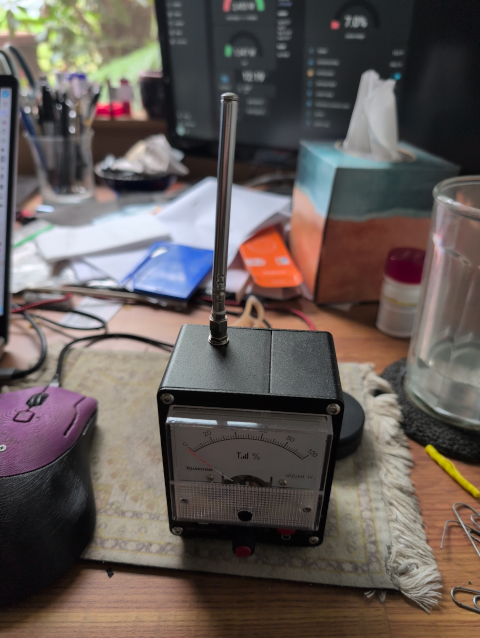
I looked up, and saw the field strength meter pictured above sitting on my bookshelf. Atop it is a simple telescoping antenna that, when fully collapsed, is close to a quarter wave at 915 mHz. It would be a poor match for a 50Ω radio, so it needs a ground plane. Ground planes don’t have to be much, so I just bent some wire around the outside of the connector making two ¼-wave radials tapering up (the antenna will be mounted upside down) at 45°.
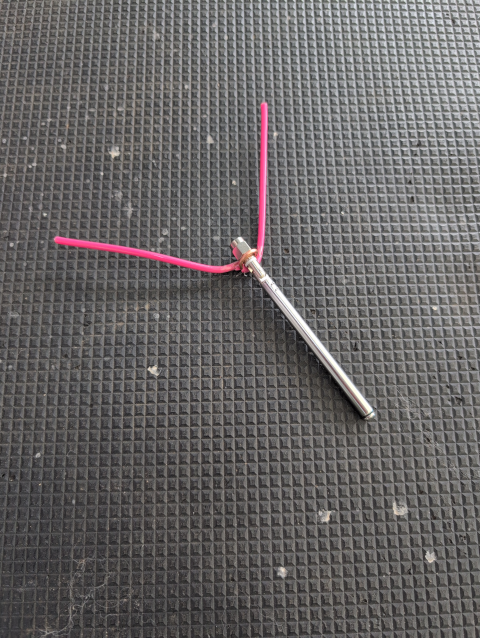
It’s only a temporary solution. I didn’t solder to the base of my telescoping antenna, because I don’t want to mess it up, so weather and temperature changes will eventually cause the ground plane to become disconnected. The vertical element is several millimeters too long, even fully collapsed. But it seems after only a few minutes that it’s working a little better than the stock antenna. The signal strength to my indoor node is usually around -40 dBm with the stubby, and it looks now to be hovering around -34 dBm. That’s a lot more improvement than I expected! Now to see if it translates to more reliable connections to nearby nodes.
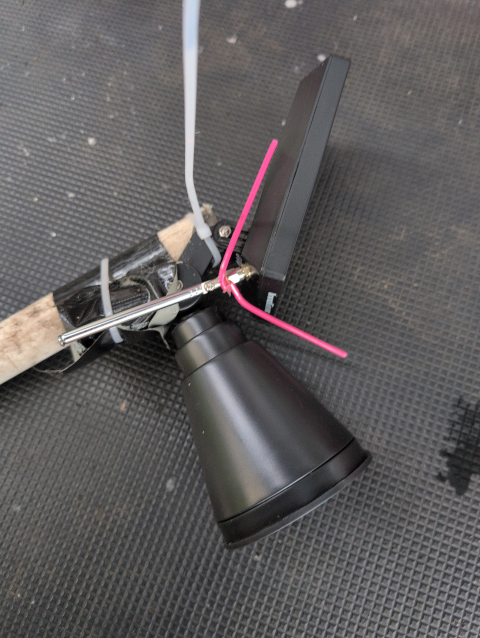
You will find people who claim that you can’t just turn a ground-plane vertical upside down. Really? We’re about 18 full wavelengths above the ground; the effect on propagation would be unmeasurable. I’m much more likely to have problems from the poor ground-plane connection (it’s already being rained on) and the wrong length.
—2p