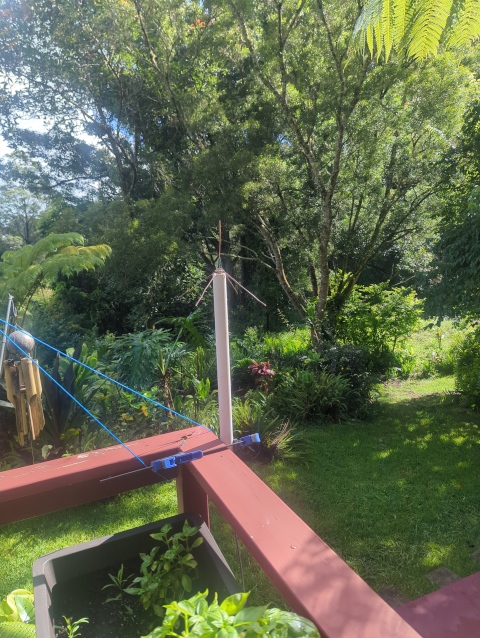
We’re still working on getting familiar with our GMRS radio network, though I think we’re close to being able to back down on our weekly testing schedule. One thing we’ve discovered is that propagation of the radio signals can be somewhat unpredictable.
There’s a big hunk of Maunakea between the east and west sides of the ‘hood. I’m in the southwest part, and I can communicate directly with everyone except the handful of radio folks in the southeast part. They’re blocked by the mountain. So one of the radio-geeky neighbors who lives to the north (and can “see” both sides of the neighborhood from his home) built a repeater that does a fabulous job connecting the east and west segments… most of the time. My neighbors and I are usually loud-and-clear through the repeater, but sometimes my across-the-street (to the east) neighbor and I come through only with a tremendous amount of static, though my next-door (to the west) neighbor comes through fine as do the folks even farther south, away from the repeater. We like to blame it on the rain, but it’s been raining pretty much every time we’ve done testing. I’m just going to call it propagation voodoo.
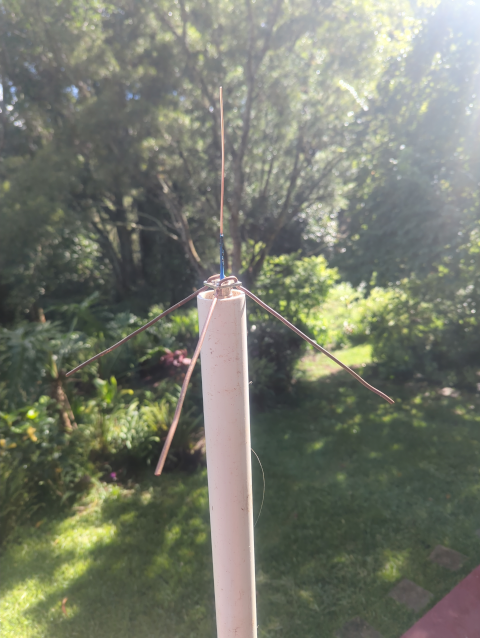
I built an external antenna (we’ve just been using the whip antennas that come with the radios) out of a PL-259 connector, three pieces of copper wire, and some solder. I finally got it connected today and tested it with a brand-new vSWR meter, which (assuming I’m using it correctly) declared it a perfect match with the radio. I could trigger the repeater, but nobody else was listening to help me test. If it works, it might be a good solution for those of us with metal roofs (the majority around here) who have to be outside to get the radios to work at all. It also might be an answer to the repeater reachability issues. The connectors currently sell for about $1.60 each and the cost of the wire and solder are negligible. The cable would probably be the biggest expense, along with the (minimal) labor to assemble the things and the (variable) labor involved in installation and cabling.
The antenna, for those who care, is what’s called a “quarter-wave ground-plane vertical.” The vertical element is ¼ wavelength at GMRS frequencies, about 462.6 MHz. I used 154.0 mm. The four ground-plane elements must be at least ¼ wavelength; otherwise the dimension isn’t critical. The antenna should be positioned at least ½ wavelength (~300 mm) away from any metallic structures, and the connecting cable should run vertically away from the antenna for at least ½ wavelength. Otherwise, it’s just about the simplest antenna one can make given that even a ½-wave dipole would require matching circuitry to connect to most radios.
—2p