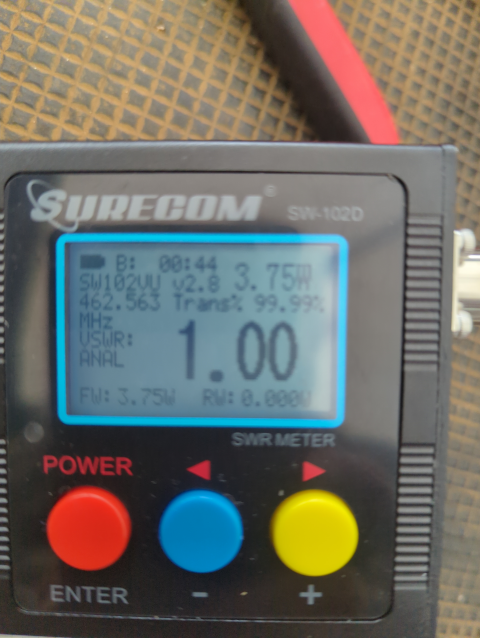
When I first tested my quarter-wave ground plane GMRS antenna I was rather surprised to measure a voltage standing-wave ratio (vSWR) of 1.00. vSWR is a measure of how well an antenna is matched to a radio transmitter and a transmission line (cable). A value of 1.00 is… perfect. It seemed way too good to be true.
Why was I surprised?
When I last did serious work with antennas, it was the early 1970s. We were generally using much lower frequencies then, so the wavelengths — and thus the antennas — were much longer. I think my first quarter-wave ground plane antenna was most likely in the 10-meter band, so the vertical element of the antenna would have been 2.5 meters long… almost 100 inches. Fabricating such things (remember, they have to live outside in the weather) was challenging for a pre-teen. Decent transmission line cable was tough to get and expensive. I was thrilled if I measured a vSWR of less than 1.5, though the goal was to get below 1.25. So on my first antenna in half a century, which I put together in an ill-equipped shop in my garage, I did not expect to do so well even though I was working with much friendlier dimensions. (This vertical element was 154mm, or about six inches.)
The meter I was using to measure the vSWR was brand-new. I was worried that I just wasn’t using it right. I decided to deliberately make a “bad” antenna to test, so I clipped a wire onto the vertical element of the antenna at a point that was likely close to an antinode. That’s a spot that should really mess up antenna performance.
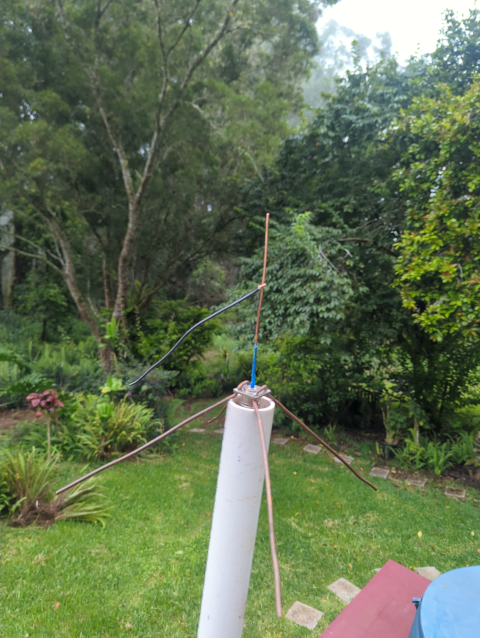
I attached my handheld GMRS radio, the SWR meter, and the antenna together. I fired it up, and…
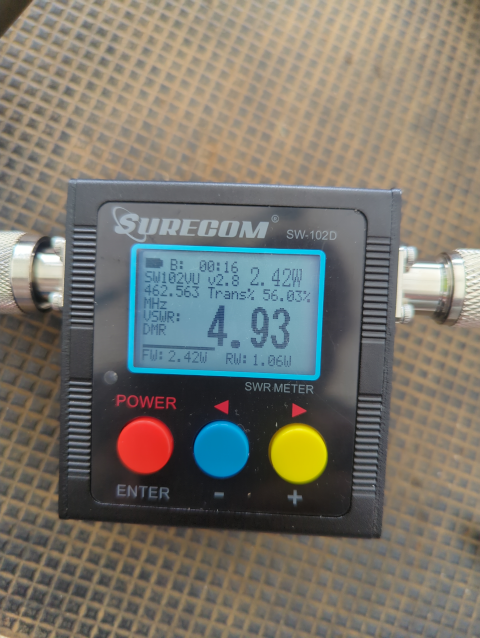
That’s about what I’d expect from a truly messed up antenna. I imagine it wouldn’t be much worse than that if I disconnected the antenna altogether, but that can actually damage the radio. It appears that my little antenna really is as good as first appeared.
It is true that, just like in medicine, you can have really great diagnostic test numbers and still be really sick. However, the simplicity of this design means there are no potential resistive elements (things that soak up the radio-frequency energy and just get hot) so everything coming out of the transmitter (close to 4 Watts) is actually radiating out of the antenna. If it’s a good antenna, the radio energy is radiating equally in all directions along the ground and not so much up into space, as I’m not trying to communicate with a satellite. I suspect this is working pretty well, though I haven’t been able to raise anyone else so I’ll have to wait for our radio test on Sunday to know for sure.
—2p
addendum 2026-07-18T17:16-10:00
I decided to actually read the manual on the SWR meter today. I learned that I have been using it correctly. I was amused that they said…
The ideal SWR reading is 1.0, but this reading is usually possible only under laboratory conditions…
Yee haw! My little antenna is lab grade!
addendum 2026-07-22T12:01-10:00
Sunday’s test seemed to go pretty well, though there are many variables so one test probably doesn’t tell us much. One thing for sure, though, once I permanently mount the antenna and bring a cable indoors, it will be nice not to have to go out into the rain to use the radio — which otherwise doesn’t work well at all from inside the house.