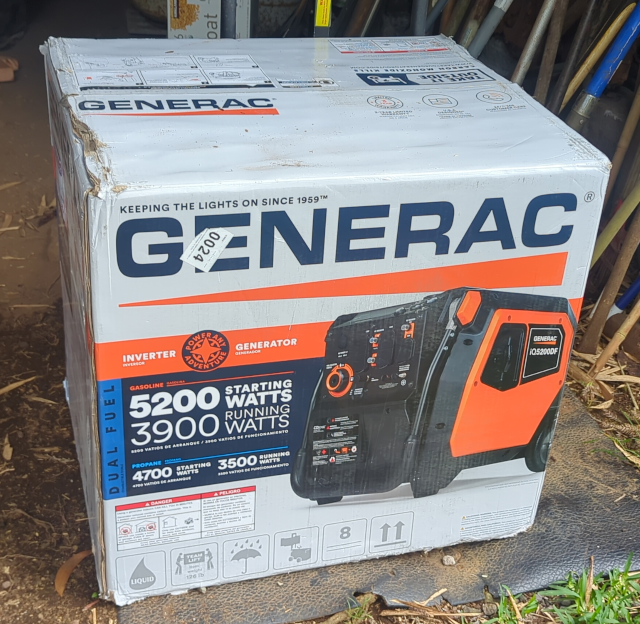
It turns out that we’ll be having to use a backup generator more than I had hoped. It’s still not much, and I might have a workaround, but for now the ability to occasionally have backup is important.
the existing generator
The existing generator (“the Beast”) was working, but only if I fed it ethanol-free gasoline. I had hoped to run it on propane, but the house inverter would reject it when running on propane. Even regular gas (with added ethanol per federal law) would cause it to run too rough. We were getting by with ethanol-free, but then one day even that stopped working. If I’m very gentle with the generator, only pulling 2,500 watts out of its rated 13,000, then it will work. But it’s loud. I’m embarrassed to run it as I fear it’s annoying the neighbors, though they’re too polite to complain. Even if they don’t care, it annoys me. And at ¼ capacity, I’d have to run it several hours when those strings of dark days occur.
inverter generators
I decided I needed an inverter generator to consistently make the power clean enough. The house inverter needs 240 volts, though, and I couldn’t find a 240 volt inverter generator anywhere on the island. Shipping one here adds about a grand to the cost and about three weeks to the wait time. I have four broken 120v inverter generators in the shed, so clearly they’re problematic. Still, I decided that the best solution was probably to modify my solar plant so that I can just plug in a 120 volt inverter generator that I can pick up at several local hardware stores. I selected the Generac inverter generator above as it’s portable, gets high ratings for reliability, and I could get one delivered here. It came today. It has a three-year warranty, so even if I have to rely on warranty repairs/replacements, at $900 that will only amount to a dollar a day. I’ve also learned that one does well to really limit how much you tax these generators: drawing half their rated running power will make them last much longer.
autotransformer
To make it work with our 240 volt house inverter, I’ll need an autotransformer which also arrived today.
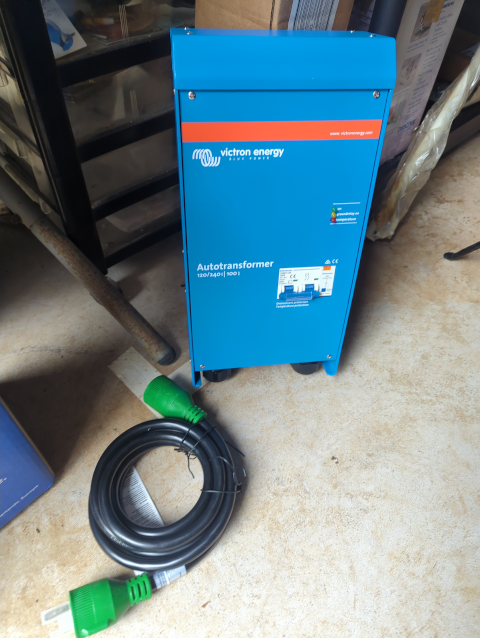
It was about $500, and I’ll have to add pigtails for the 120 volt input and the 240 volt output, but I have the materials to do that. It has almost no moving parts (a small cooling fan) and is >99% efficient. It also isn’t weatherized, so I’m going to put it inside the sound-insulated generator house I’m building. It’s far quieter than the Beast at baseline, and the acoustic enclosure (which I designed to make the Beast tolerable) should make the new inverter generator nearly silent.
So… if this works as planned, we’ll have solved the power quality problem and the noise problem. We’ll have to run it for longer on those unusual occasions when we need it, but it won’t be problematic to do so.
bonus: using the Tesla battery
When I first conceived all this, part of my plan was to use the 85 kWh battery pack in Joulee the Free Salvage Tesla as backup. The Model S doesn’t support vehicle-to-home power, but I can retrofit that. It would void the warranty, but Tesla unilaterally voided my warranty anyway so I no longer have to worry about that. The machinery to make that happen would have been pretty expensive if I needed a 240 volt system, but now that I can get by with 120 volts, I can get the needed equipment for a few hundred dollars. It probably isn’t practical while we’re still using the car for transportation, as I’d have to park it at the far end of the property, but 85 kWh would get us through four or five days without sunshine and so reduce our generator needs considerably. It might represent a real option for when something fails on Joulee that would be too expensive to repair.
—2p