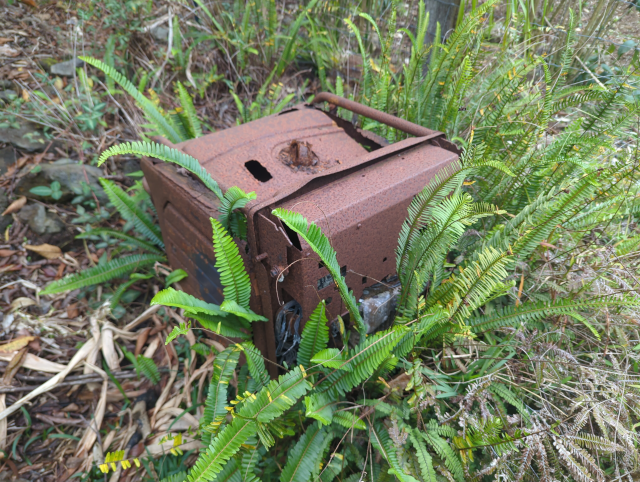
Let’s start before the beginning. The house, as near as I can tell, was electrified in the 1930’s or 1940’s with knob-and-tube wiring and overhead lines connecting to an old generator. The one above might be an original or a replacement, but it has a cast-iron block and the frame has rusted away to the point where moving it without an excavator or the like would be impossible. I’m planning to let it rust into the earth where it sits. The oils, gas, and other volatiles are long gone (likely into the earth and air, alas).
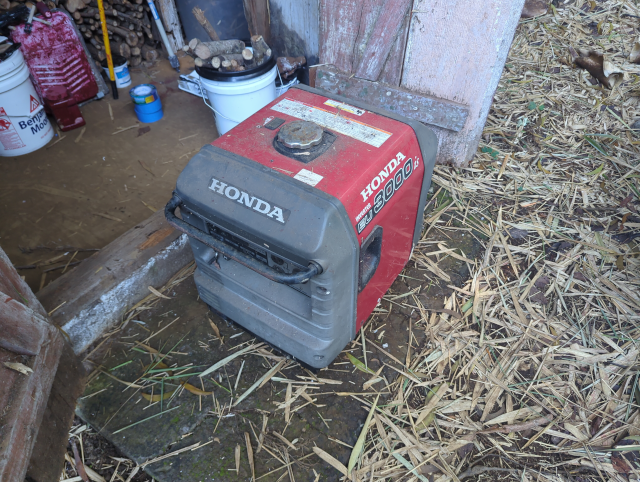
Apparently there have been many generators recently. When we bought the house, Rob was using a Honda EU3000is, a very nice portable generator that’s quiet and reliable. When he was staying in the house after we bought it, he called one day to say that the generator had died.
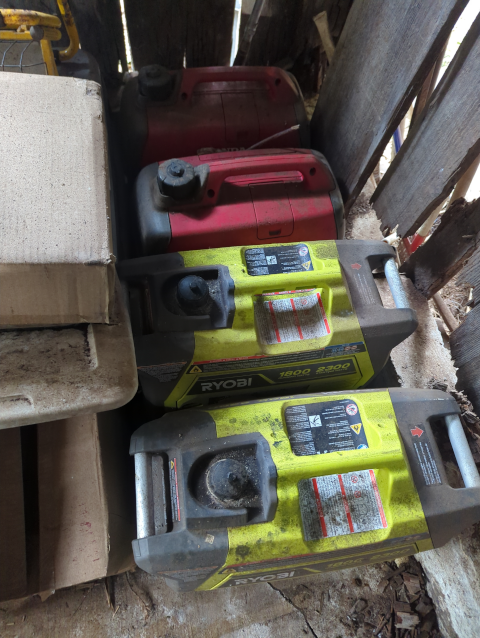
We didn’t want Rob to have to stay in the dark while we figured out what to do with the broken generator, so we called Home Despot and got a sub-$1,000 Ryobi generator that he could pick up. Turns out, unbeknownst to us, he had already done the same thing and it was actually the almost-new Ryobi, not the Honda, that had given up the ghost this time. He put the new one in, and life was okay. The new Ryobi also died after a few weeks, but after Rob had left.
There actually was an entire generator graveyard.
We replaced the Ryobi with another Honda EU3000 as we figured buying cheap little generators would just lead to more failures. I really liked the Honda. It was quiet and seemed to do its job with aplomb until we got our big solar plant installed. At that point, it could no longer serve us as it is limited to 120 volts and the plant requires 240 in a backup generator. I gave the new EU3000 to some dear friends who have been of immense help in our island adventure.
After some problems getting the generator backup working, we had a noisy but useful system for almost a year until a few days ago.
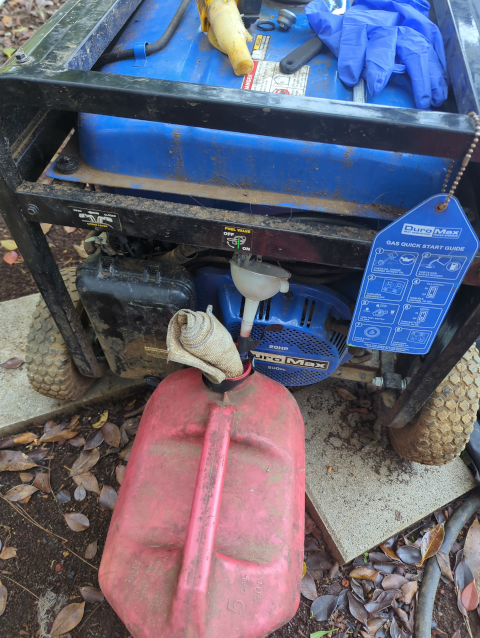
But we still had five generators in the shed, plus the one mostly working for the solar array, and one dissolving in the back yard. It was understandable, then, when I approached HA with the idea of buying another generator, she wanted to know if there wasn’t some way we could make a working one from what we had on hand. I thought not, because only the big, balky one was a 240 volt generator which is what we needed.
Then I discovered that you can get 100 amp autotransformers that will convert 120 volts to 240 volts, shipped to the island, for about $500. That means that if I could fix the EU3000 that broke when Rob was using it, we could make a system to charge our batteries in times of wan sunlight that would be quiet and reliable and not cost much.
The truth is, we just decommissioned that EU3000 when it quit running without trying to fix it in any way. It could just need a spark plug or fuel filter. It could even need a whole new inverter board (about $300 on eBay). But in any case, the EU3000 repair and the autotransformer together will cost a lot less than a new generator, will save at least one of our collection from the landfill, and set us up to be able to replace a bad generator with a 120 volt unit if we need to in the future. The Beast (the 13 kW DuroMax) can serve as a standby or an emergency car charger.
So that’s the path we’re on now.
—2p