Hawai’ian Telcom
This is irony. When I went to publish this column, I discovered that my ISP, Hawaiian Telcom, is having a serious but intermittent routing issue. They’re dropping most packets between the island and a big block of Hetzner IP addresses in Oregon, including the server that hosts
twoprops.net. It likely affects a lot more than just Hetzner, but that’s all I can check. I have no problem with my servers hosted at Hetzner’s East Coast center. So just posting this column has been interrupted now for many hours. There is no way that the holiday weekend front-line staff at Hawaiian Tel could even understand that there’s a problem. You can only reach them by phone, and they’ll just tell me to unplug my router and plug it back in.
Satan’s own mower
Doing projects on the island is fraught with interruptions. A couple of weeks ago, now, our riding mower, a Murray MT100 — or, as I now call it, Satan’s Own Mower — threw a deck belt. The deck belt is a consumable part. It is expected that it will break multiple times in the life of the mower and be replaced by the consumer. It was a traumatic failure and the belt was rendered into a pile of strings, so matching it with a replacement simply wasn’t possible.
When it broke, I looked in the manual and got an OEM replacement part number. Then I went to the Murray site, where I learned that Murray does not sell parts. Even consumable parts that the end-user will be expected to replace multiple times in the life of the product. “Contact the dealer,” they say. My dealer? Home Depot in Hilo, a 2½ hour round trip away. Can Murray tell me the specs of the part? No, “contact the dealer.”
I called Home Depot. “I don’t think we sell those kinds of parts.”
I checked Amazon and they have what purports to be the right belt, but the pages that have the belts have a big warning that they are a “frequently returned” item and that you should check the actual requirements (which Murray keeps secret) because too many customers have complained that the belts don’t fit.
I happened to be driving through Hilo one day, so I stopped at Home Depot. The very same Satan’s Own Mower was parked out front, for sale. When I asked about replacement belts, I again got “I don’t think we sell parts.” “But I bought it here,” I replied, “and the manufacturer says this is where I should get the belt.” They then said if they have it, it would be on aisle XX.
Off I trot to aisle XX, where a friendly associate was hanging out. I inquire. “I don’t think so” he says. “But if we have them, they’d be here” and takes me to a display of belts several aisles away.
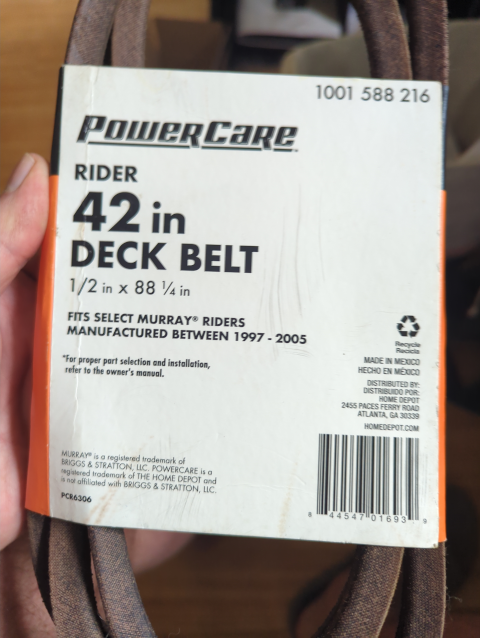
Lots of belts, but not a single one that says it fits Satan’s Own Mower. The sales associate spent some serious time on his phone looking stuff up, and eventually says that the belt pictured above is supposed to be the right one. “You can always return it if it doesn’t fit.” Right. Except for the 2½ hour drive and the time I spent trying to install the wrong belt, which turned out to be a much bigger deal than I could have imagined.
Now home with the right belt, I dropped the deck on the mower and proceeded to follow the single-page instructions from the manual and an online video that Murray publishes. Oddly, there are almost no online videos available not produced by Murray. I should have seen that as an ominous sign.
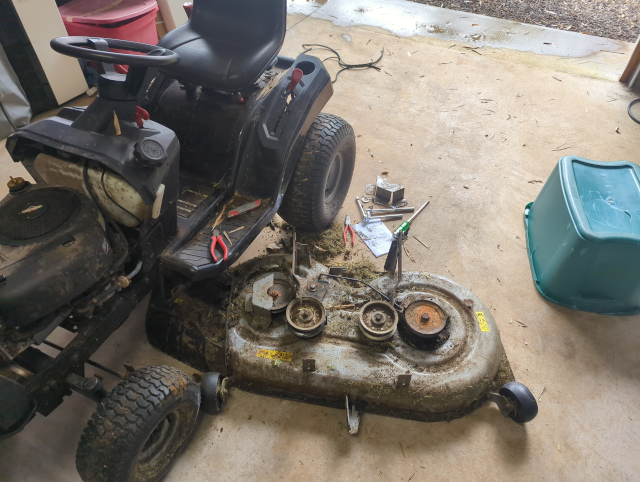
For a consumer-level repair, it’s a fairly complex set of instructions. What’s worse, though, is that the instructions are wrong. I thought, perhaps, the video would help, but the video is worse than worthless. First, no surprise, the mower in the video is factory-fresh and spotless. Next, the bolts have been pre-loosened: the actor in the video holds the head (not the handle) of a ratchet and removes the bolt holding an idler pulley using the tips of three fingers. In reality, that particular bolt tightens with rotation so on a mower that has actually been used, it requires a lot of torque to remove it. However, the bolt is on a spring-loaded idler pulley so attempts to loosen it just rotate the idler arm and stretch the spring. Just trying to brute-force the bolt would simply stretch the spring likely to the point where it would no longer work properly when re-assembled. I ended up having to cut a wood block to the right size to support the idler arm, and then put a two-foot breaker bar on the bolt.
Can it get worse? Yes, it can. There are two metal tangs that stick up on the leading edge of the deck. They serve no obvious purpose (I assume this deck is used in other makes and models of mowers that might take advantage of them), but one is strategically located to insure that, should your socket wrench slip while removing the idler pulley bolt, the tang will put a serious cut in the back of your hand. Fortunately, I’ve been doing this sort of thing long enough that I saw the danger in advance and wrapped a rag around the tang. Glad I did, because the socket did, indeed, slip off and I bruised (but didn’t gash) the back of my hand when it hit the rag-wrapped tang.
Having removed the cable clip, five cotter pins, six bolts, two shrouds, two nuts, and two pulleys I was now able to remove the shredded remnants of the old belt and put the new one on.
Then the fun began.
“To reinstall the mower deck, reverse the steps above.” That’s it. That’s the entire guidance they give. It’s hard to convey how lazy and arrogant it is to say that. A 10-year-old can disassemble a V-8 engine, but re-assemble it by “reversing the steps above”? Impossible.
One of the disassembly steps was to “slip the belt off the drive pulley.” Of course, I didn’t have to do that because the belt was long gone from that pulley. Presumably, reversing that step meant “slip the belt on the drive pulley.” The drive pulley, though, is completely surrounded by a steel cage. No mention of that in the instructions. In the exploded parts diagram, the cage is conveniently missing. Perhaps the video? No, in the video, also, the cage is simply not there. Obviously, the cage has to be removed to “slip” the belt over the pulley, but removing the cage is a Herculean task as it involves finding and removing a nut that is hidden deep within a U-channel that is not visible without actually putting the mower up on some kind of lift (the Hand improvised some ramps to elevate the mower enough to see) and it still requires two people to remove the nut. No wonder Murray chose to fraudulently omit the existence of the cage in their instructions and videos. No intelligent consumer would buy a product that was so difficult to maintain.
Remember, this is a procedure that the end-user of this mower is expected to do on a regular basis.
So what did I discover after hours of going through this procedure? The belt that the Murray dealer sold me was the wrong size. Close enough that you can re-assemble it (with a lot of effort), but so short that the engine crank can’t turn even with the deck supposedly disengaged. The only online reference I found to this problem was a YouTuber who found that he had to buy a belt nearly five inches longer than the official replacement part.
Murray yard care products are unfit for purpose. Their maintenance documentation is wrong, Murray refuses to provide support except through their “dealer”, and the dealer is unequipped to provide that support. I will never buy another product from them. They are owned by Briggs & Stratton, which is harder to avoid, but apparently have been made worse on purpose by their private equity owners.
I have a larger (enough?) belt on order from Amazon. It was supposed to be here Friday but is now delayed until next Thursday. You cannot get the belt at Home Depot (the Murray dealer!) or Lowes or the auto parts store.
Many projects around here go like that. Expertise and parts are challenging to obtain, and once you do the project has been delayed enough (I think I’ve been working on the mower for three weeks now) that you spend a lot of time keeping parts together, putting tools away and getting them out again, not to mention that you’ve been without essential equipment while you wait. By the time the mower is repaired on island time, I’m going to be mowing through knee-high grass.
—2p
addendum 2026-10-02T16:43-10:00
The belt on order was repeatedly delayed. I finally ordered one from a different company, for three times the price. Moments after I placed the order, I got notified that the original belt was just delivered. I tried to cancel the new order, but couldn’t.
The belt installed without incident (much easier to do the install when the belt isn’t five inches too short!). I drove to the lawn, engaged the mower deck, and a cloud of smoke emerged from under the mower. I immediately shut it down, but the new belt was already destroyed.
My current theory is that the deck is seized, which may have been what killed the original belt. Now I have the new-new belt, and I’ll install it and check the deck to make sure it spins before I engage it.